
projects | Viabizzuno progettiamo la luce
discover all the Viabizzuno designs and projects in collaboration with the world’s leading architects and designers.


 en
en
cantina la brunella
place:castiglione falletto, cuneo
project:studio architetto boroli
lighting project:guido boroli
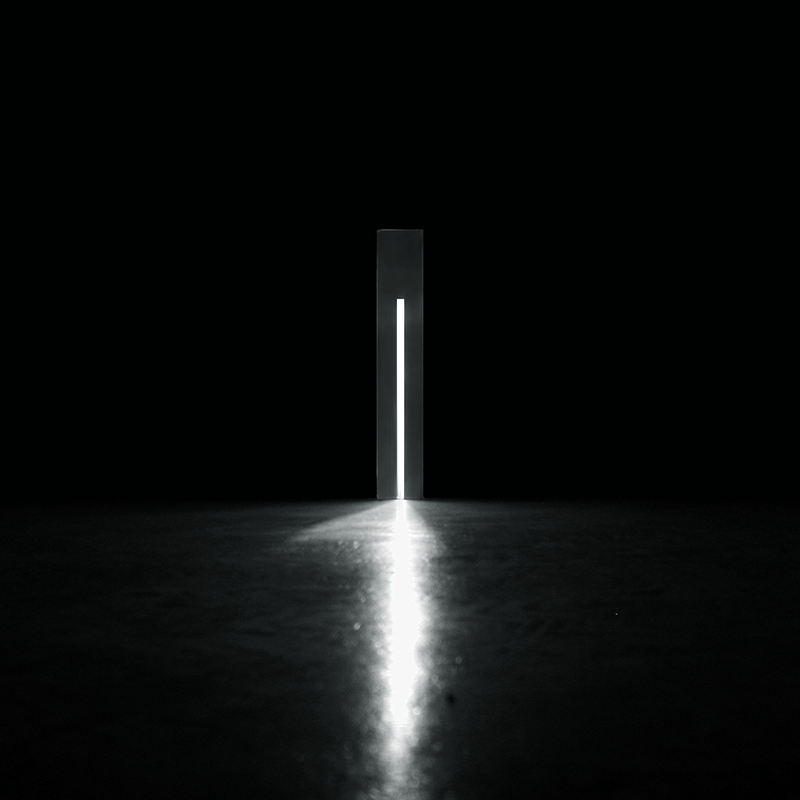
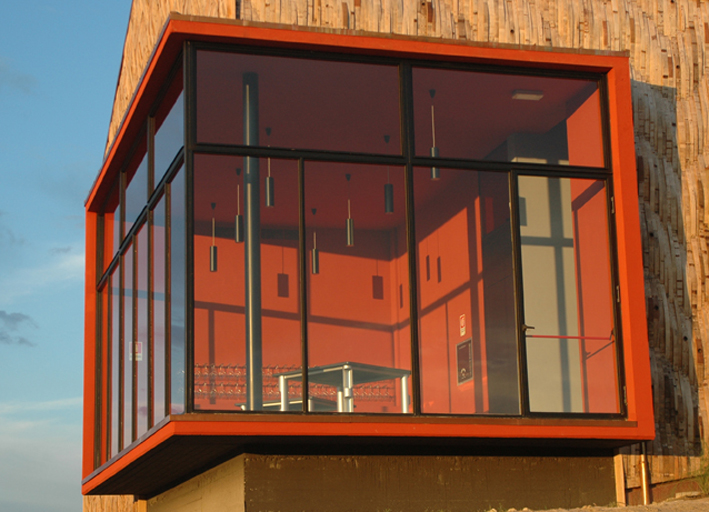
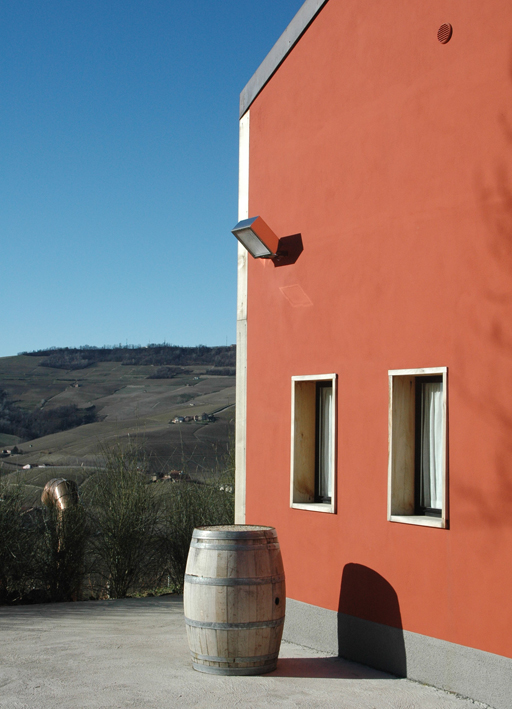
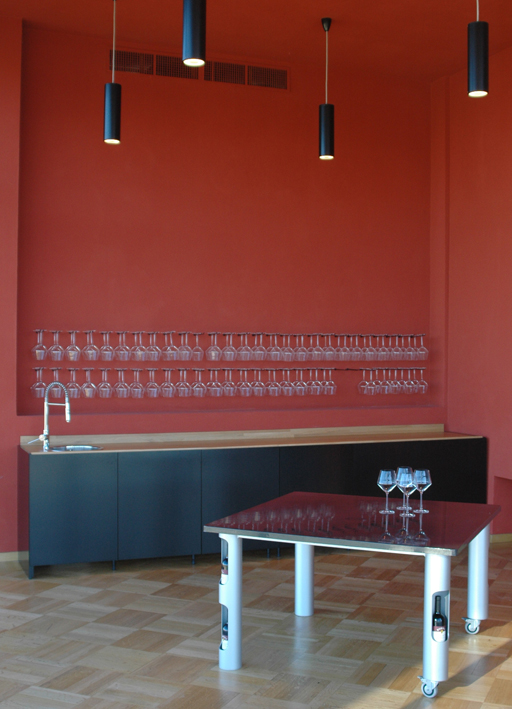
la brunella wine cellar is a structure for the vinification, ageing and refining of nebbiolo da barolo and prime-quality cerequio and villero cru. the cellar is located in castiglione falletto, in the heart of the barolo-producing region. the initial approach to the project for enlarging the cellar was influenced by the pre-existing structure: la brunella, originally built in the seventeenth century and enlarged several times since then, is an ‘l' -shaped building crowned with a small tower where the two arms meet; from here there is a magnificent view of the vineyards belonging to la brunella and of the barolo valley. every design decision was influenced by the necessity of not seeking formal or architectural continuity by copying the forms and geometrical lines of the building, which would have meant building a false-antique unit, but by re-interpreting the original lines in a modern key. this clearly emphasizes the new structure so that both new and old can enjoy their formal and architectural independence. also, a most significant point, the functional aspect was accorded greater importance than the formal. the structure built consists of one floor below ground level where the ageing process can take place, and one above ground where the wine can be bottled, labelled, and packed. the covering consists of two gables supported by trusses in laminated pine and double tie beam in steel, and copper facing running from the ridge to the valley gutter in a single sheet. a large tasting room, with two sides made entirely of glass overlooking the vineyards, is at a height half-way between the ground floor and the cellar, surrounded by rows of nebbiolo vines. the rows of vines are perpendicular to the spectator who is thus able to appreciate both the quality of the grapes and the slope and exposure of the barolo bussia vineyard. opposite this spectacle, on the blind wall towards the cellar, a long glass slit window, no higher than a bordeaux magnum, reveals the place where the wine obtains its structure, its colours, and its scents, slumbering gently at a natural temperature ranging from ten degrees in winter to seventeen in summer. the red bricks of the walls make the space recognisable both from the interior and the exterior. the duramen oak-wood floor calls to mind the prized essence which protects and nurtures the fine ‘red liquid so loved by noah' for months and years. next to the landing of the steps into the sampling room the visitor may discern a smaller blind passageway. opening the door reveals a staircase enclosed on all four sides, like a tunnel, a small passage ending in a platform leading to another floor. as visitors take to the staircase, small rays of light illuminate the edges of the treads, measuring out their footsteps. the surfaces of the walls and ceiling are faced with pine wood, perfectly smooth. the climate changes: the air, step after step, becomes gradually more humid, heavier, colder. and now you reach the last step, a small platform at the centre of a silent space, where the air is heavy with the scent of wood and wine, where hundreds of barriques, casks and tuns lie. large black circular pillars support the round floor, almost as if to proclaim the static safety of the place, while the black walls at the end of the room serve to conceal the dimensions of the space, blending into the shadows. the round shapes of the casks and barriques stand out, lit from above, warming the atmosphere with their ochre-yellow colour marked by violet streaks of barolo; it becomes impossible to do other than step off the platform and go forward into the half-light, strolling among the barriques to admire them and to listen, in silence, to the voice of the wine.
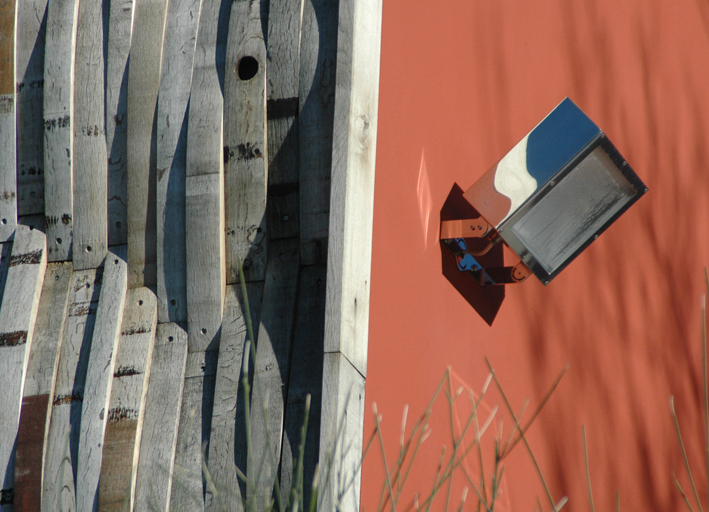
once one reaches the end of the walkway, originating from the organisation of wood to make optimum use of space, one may turn and admire the cellar in its entirety, appreciating the dimensions and the scenic effect; and the tunnel one has just traversed looks like an object, a sculpture. the exterior walls are faced with staves of duramen pine wood and a small beam of light illuminates them from above, creating interplay of light and shadow within these regular volumes. it seems almost a container created with great attention to detail and design, where the company prepares and packages its bottles for sale to the public: the proportions, the scent of wood, the design of the staves, are all the same as a container. immediately beside this volume, through the penumbra appears the light from the slit window which from the tasting room had given us a small anticipatory glimpse of the cellar; and now, from the deepest reaches, the blue of the sky can be seen: from inside to outside and vice versa, glances and glimpses meet and intertwine, confronting the world of nature and her fruits with the world of man and his products. emerging from the building, there is a spectacular view of the entire façade, almost ten metres high and faced throughout with wood. here and there, looking upwards, panels may be observed, made from staves and faced on the inside with sheet steel, distant enough to reflect the beams of the lighting fixtures concealed there; this blue lighting is most effective seen at evening when the entire structure is lit with reflected light, never direct light, so that the colour of the façade blending with that of the wood recalls the colours and shades and highlights seen in wine poured into a fine crystal glass during a tasting session.
climbing the stairs you enter a huge full-height space with walls faced in red resin, the structure of the roof clearly visible with its tall slender gables in laminated wood; the window frames of different sizes edged in black aluminium enclose, as if in a picture, the view of the landscape which changes repeatedly as one comes closer to the glass. and in the corner towards the tasting room an irregular volume can be seen, with staves in duramen wood emerging from the floor as though they were the continuation of something there in the cellar. the smooth grey concrete floor has a small gutter for the water used to wash the steel tanks and is dominated by a mighty piece of mechanised machinery which is responsible for the entire wine production cycle. on the south wall, a zinc-coated iron staircase leads to a mezzanine where the offices and a large table for meetings are situated. a large triangular window, which can be partly opened, gives a view overlooking la brunella. below the stairs, twin doors lead to the utility rooms from which one entered at the beginning of the visit.
scroll


 Page loaded in: 0.125 - Powered by Simplit CMS