
projects | Viabizzuno progettiamo la luce
discover all the Viabizzuno designs and projects in collaboration with the world’s leading architects and designers.


 en
en
wittlinger hahn stern radiologie
place:schorndorf, germania
project:ippolito fleitz group, identity architects
lighting project:ippolito fleitz group, trieschmann gmbh
the successful joint radiology practice, wittlinger hahn stern has moved from its old premises in the centre of schorndorf (a town about 35 km east of stuttgart) to the town's new health centre. the practice occupies a 600 m² area in the basement of the building.
the main design challenge for this accommodation concerned the interiors, combining the necessary high degree of technical organisation with a clean and functional layout. the radiology practice experiences high patient numbers, long waiting times due to the complicated diagnostic procedures and nervousness on the part of its patients. the careful and considered design of the interiors and arrangement of space stemmed from the great importance attached to the state of mind of those obliged to attend a radiology clinic. the mood of visitors to a radiology department is often one of apprehension, heightened by a feeling of uncertainty generated by the array of technical equipment and one of anonymity brought on by the institution and the labyrinthine layout of its premises. the interiors of the wittlinger hahn stern radiology clinic are designed with great sensitivity; the waiting rooms convey a sense of security, the direction signage is designed to make it easy to find one's way around and the technological apparatus remains largely hidden. this all instils greater peace of mind in patients, who begin to feel they are in the right place. the layout of the clinic is organised around the centrally located patients' waiting area and the individual function areas - nuclear medicine, mri and cri, x-ray, mammography and ultrasound - are grouped around it. this clearly structured arrangement makes those based around maze-like corridors obsolete, while distances between the treatment rooms and the waiting area are so short that a loudspeaker system is not required, making communication direct, agreeable and personal, rather than anonymous. there is an unobstructed view of the main waiting room right from the entrance, giving patients an immediate sense of orientation on arrival, which is also helped by the use of colour; the ceiling is light blue and this colour runs from the entrance to all the publicly accessible areas.
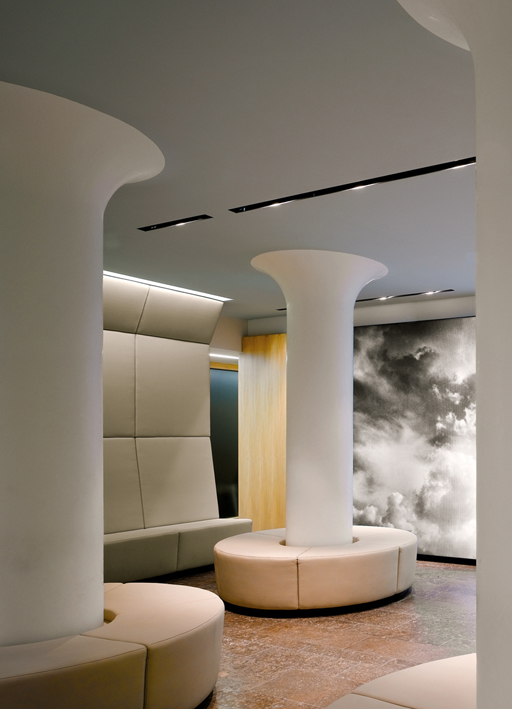
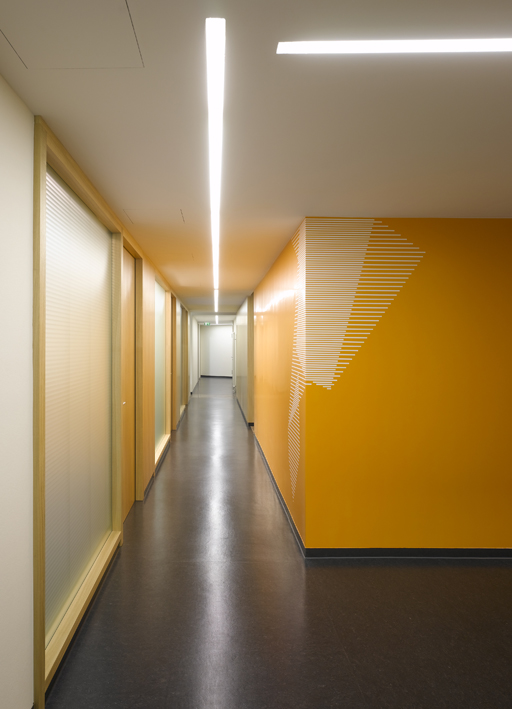
the reception is the organisational hub of any clinic and also the first point of contact, essential to building a trusting relationship with the patient. the two reception areas are contained in partially enclosed units to the left and right of the entrance area, conveying a firm sense of discretion. away from the reception area, the space tapers towards the central waiting area. the room is defined by three freestanding walls with an exit formed at the end of each, leading to the operational areas around it. the walls also serve to screen the corridor that runs right around the central core. this means that those waiting are not disturbed by the bustle of activity outside the waiting area and medical and other staff can move around unnoticed between the different operational areas. the side walls of the waiting area are upholstered from floor to ceiling and curve into the room at the top, enclosing the people waiting and giving them a feeling of protection and security. the surface of all the upholstered walls is perforated, a way of controlling the room's acoustics so that it remains quiet even when the clinic is busy. patients waiting can choose to sit on one of a row of seats along the two side walls or on circular seating around each of the four columns. since the waiting area is windowless and has no natural light, the freestanding walls that back onto the reception area act as luminous screens; they are lit from behind, displaying an image of clouds in black and white. this motif is an invitation to meditate on the endless expanse of sky and is also a powerful symbol of hope, added to the fact that the blue of the sky, though missing from the image, is still there in the room in the colour of the ceiling. the colour indicates the various functions of the individual areas. the ceiling in the entrance and waiting areas is painted blue-grey, a colour that has associations with the medical environment and, by virtue of long lighting slots cut into the ceiling, can also radiate a shade of light that is both effective and agreeable. the colours of the ceiling, the shell limestone flooring, the wooden surfaces and the light beige leather of the seat and wall coverings in the waiting areas instil a mood of calm and composure. the corridor around the outside of the main waiting room is dominated by a powerful, warm and welcoming orange and the treatment rooms in the different operational areas are each painted in their own dedicated colour, so that the departments are clearly distinguishable from one another.
guides on the floor and ceiling provide a link with the reception area which is located next to the external wall and lit by natural light, stressing the special status of those waiting here. to emphasise the doctors' approach of being accessible to their patients, each room has a glazed partition to the corridor, which can be obscured if required.



scroll


 Page loaded in: 0.109 - Powered by Simplit CMS