
projects | Viabizzuno progettiamo la luce
discover all the Viabizzuno designs and projects in collaboration with the world’s leading architects and designers.


 en
en
theatre Via…ggiando
place:piazza san marco, milano
project:marionanni
lighting project:marionanni
photos:pietro savorelli
foreman:Viabizzuno
a light which need not necessarily be positioned where it can be seen, but in places never thought of, reaches perfection. I have always been dazzled by the charm of projected light, ever since I was a child, when my grandfather would take me to the cinema and, the film having already begun, I would thread my way between the rows of seats, brushing against profiles which would change with every frame, as though they moved at the touch of my fingers. the darkness of the cinema was the place where I first became aware of the dynamism of lighted images. I realised that the video no longer interested me only for its content, but most of all for its ability to make light. I have made lighting projects my film: I have created a variable-image light bulb. after so many “light bulb years” the emotions I experienced as a child have become reality with the creation of a small mobile theatre where I have staged the performance “8 rules of light.”
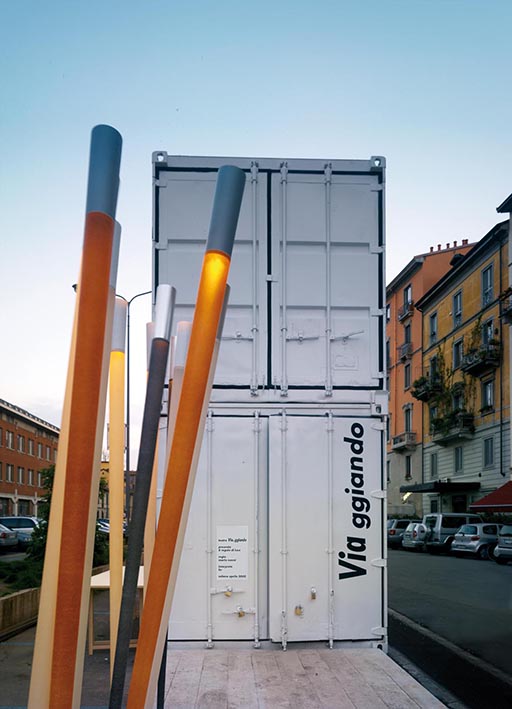
Via…ggiando Viabizzuno is a project between theatre of light and architecture; it is a space for living in, designing, projecting, installing. the container is a place in movement, a volume which moves and appropriates a space. we open it, and only then do we realise what it is: its content makes it a suitcase, a house, a theatre. it is temporary architecture, not simply contemporary. its modernity comes from the speed with which it changes, from its organised impermanence; it is the place where modularity, lightness, transportability and flexibility co-exist. from two sterile containers placed one on another our project creates a living environment, built around the life of people because inside it a story unfolds, different each time, set in motion by glances, movements, and gestures.
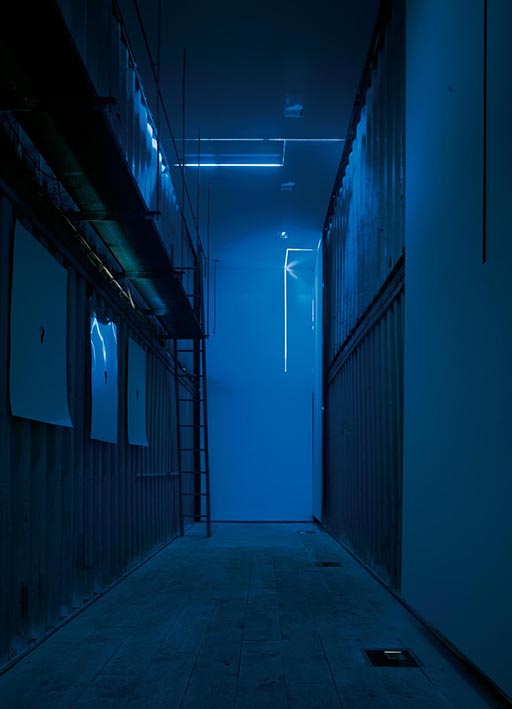
Via…ggiando arrives and a new journey begins inside it. switch on a lighting installation and its anonymous outer walls are transformed on the inside into a surface with varying images, walls broken down by the movement of light, luminous carpets on which to walk or to lie, so as to get a better view of the ceiling …which is no longer there. light has de-materialised it. this space thus becomes the place for living: ‘living does not mean only to be on earth, but also to be under the sky’ (martin heidegger). the three dimensions of space become four: we add the dimension of sense and feeling. the variable-image light bulb is the protagonist. people who live in the place called Via…ggiando bring it to life and vice versa: a dialogue is set up, coming in part from choices in design and building and in part from the curiosity and participation of those who set in motion the theatre of light. everything begins with the entrance (1). you enter from the south: the sun accompanies your route, shows you which door to open, invades the interior space, projects the shadow of the traveller on the ground, and then disappears when the iron door closes once more (2).
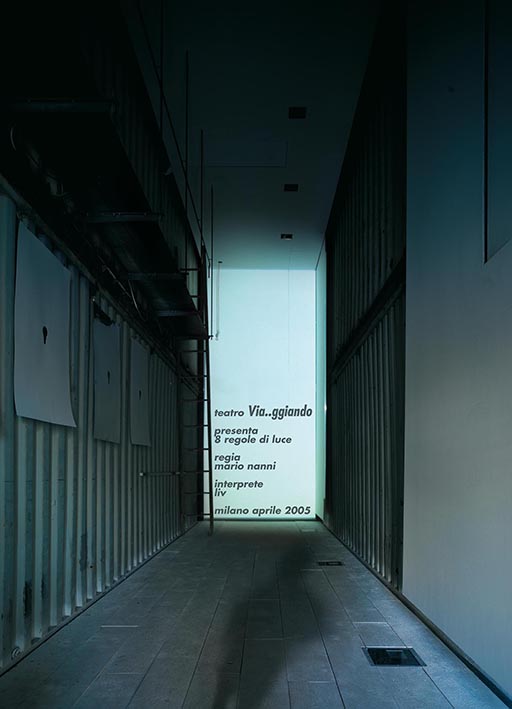
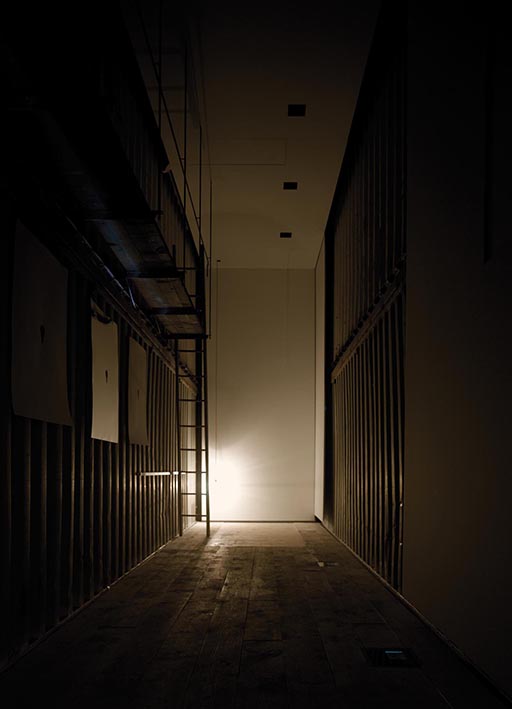
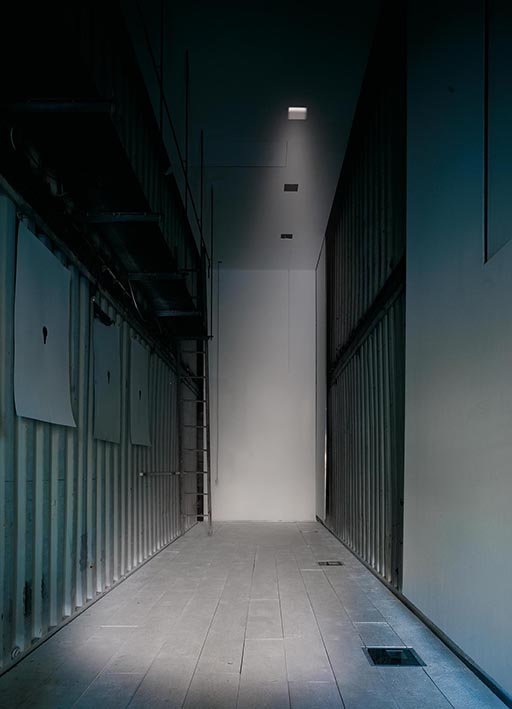
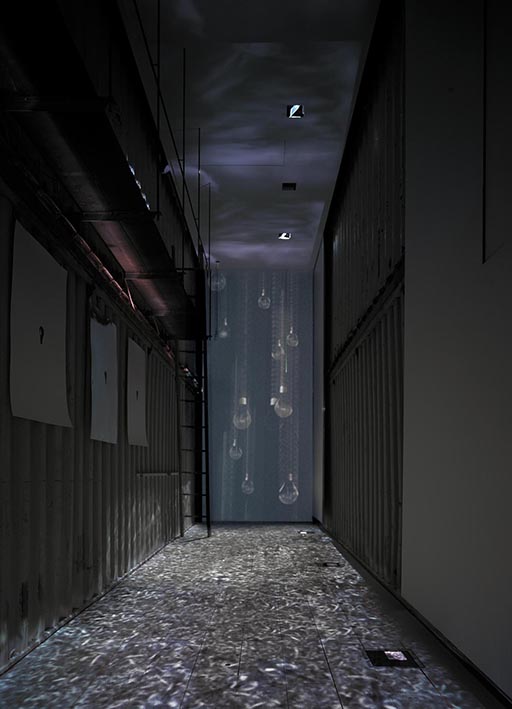
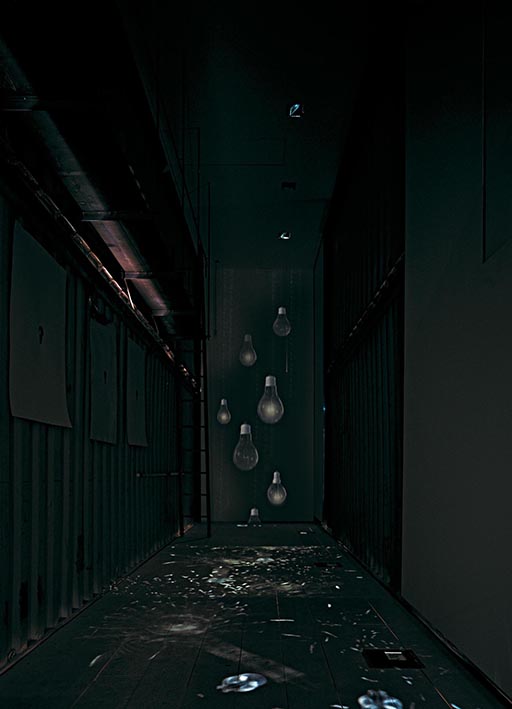
light comes in in an instant and shadow announces it, increasing slowly in front of it: the first moving light which the visitor perceives in this place is his own shadow. the eye is still sensitive to sunlight, still occupied by the image of a shadow projected on the ground, when slowly it begins to perceive the shapes of space in the half-light. only the presence of a trapdoor lets in carefully measured natural light which puts the place in focus. two containers placed one on another to create a two-storey environment, strongly vertical and developed lengthwise with regard to the entrance. the mezzanine positioned over the entrance compresses the space and makes it more cosy, but the eye travels beyond it and rests at the far end, on the high corner of the structure. it is there that the edison light bulb has been positioned (3). from this light bulb comes the modern history of light. its invention was the beginning of the end: the end of the ability and the willingness to design with natural light, studying it, shaping it, observing it; it became more convenient to position a number of light sources rather than designing with light, treating light as a material (4). the light bulb at the end of the room rises slowly, winding up its cable, and as it rises it becomes fainter: here begins the spectacle devised by one who, remembering the sun’s teaching, accepts each day the challenge of designing a well-thought artificial light, a light which lives through its intensity rather than through its lighting fixture. the room seems empty and silent, but in fact it has much to tell us: sliding surfaces, light cuts to switch on (realised with 094 system), sheets of thermo-sensitive paper to heat, variable-image light bulbs to be switched on (lighting fixture m7 and m3). a whole shower of light bulbs bursts into life (22). they rain from the sky and shatter on touching the ground: you step on them, the images of those who step on them are projected above these fragments of light.
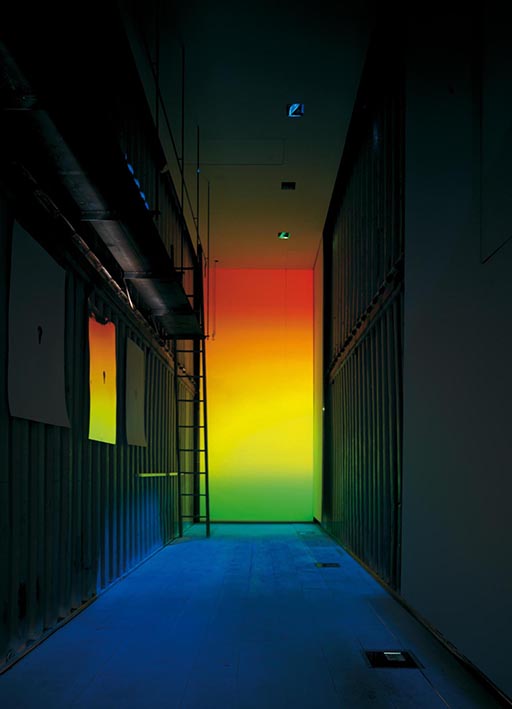
the variable-image light bulb moves and modulates light, making space three-dimensional and animating it, while remaining at all times coherent with the eight rules which govern the lighting in our home. the variable-image light bulb is not just a moving light: its movements construct and de-construct space because architecture has to be a lighting project also, a volume fashioned in the spaces and fullness of shadows (14. light as a building material); these movements modulate the intensity of light, since it is not the quantity but the quality of lighting which underlines the added value of a project and enhances it (5. light only where it is needed); they give unexpected solidity to flat surfaces, since what has solidity has volume and what generates shadows has solidity … which is non-existent without light (11. the thickness of light); they colour materials in the home by means of a spectrum of light which permeates a space and delicately immerses us in total overall colour, the synthesis of white light (18. light generates colour); they create a light which is able to leave space for darkness and shadows, the intrinsic strength of light (7. tribute to shadow); they are perceived but not seen: the presence-absence of light is a journey in space-time which breaks down the boundaries of matter – presence of light, absence of the lighting fixture (16. presence and absence).
the home becomes a sensory experience, the enchanted place where one can experience a pleasurable sensation through the light which enfolds the space (26. the emotion of nothing), to the point where it is the place within which desire becomes concrete satisfaction, partly through the technological inventions of mankind: projection, lights, installations, etc… these facilitate and even multiply the cognitive capabilities, feelings. an unexpected spectacle where matter is transformed to immerse us in another space, far distant from the non-space; a light which belongs to us and resembles us, which takes the stage in the container as at the forthcoming miart event, with the collaboration of the ‘studio la città’ art gallery, but also inside our homes. it is the observation of everyday life, and the sensitivity in capturing all the shades of light, which strike us and go with us, and which give rise to a study of the variable-image light bulb. this is a work of research and experimentation to discover a new way of lighting, intending to meet the needs of demanding daily domestic life, and attentive to the opportunities for customising; this is a research spirit which may lead to a product… be it artistic or commercial. on the ever more blurred boundary between art and design, the variable-image light bulb traces the route of experimental study. light must be observed and recognised; the tv sets which light up the ceilings and walls of our homes colour them in shades which appear and disappear, giving sensations of light and not of contents, as if they were lampshades emitting a dynamic light. instruments which are observed not so much for the images, rather for the moving light they generate in our living rooms. try turning the tv set towards the wall instead of towards your eyes in order to train the eyes to accompany the mind to a fantasy land. it is pleasurable to make light one’s own, it is pleasant to make a place one’s own. this has been the spectacle of the variable-image light bulb in the Via…ggiando container.
scroll


 Page loaded in: 0.078 - Powered by Simplit CMS