
projects | Viabizzuno progettiamo la luce
discover all the Viabizzuno designs and projects in collaboration with the world’s leading architects and designers.


 en
en
lynn library
place:belfast, united kingdom
project:consarc design group, belfast
buyer:queen’s university
lighting project:jazan designs ltd
photos:gordon mcavoy
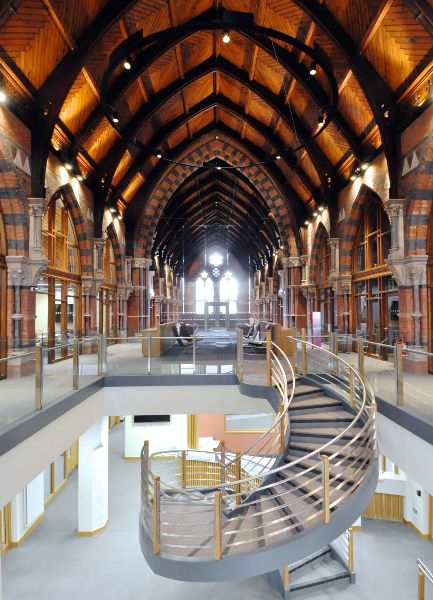
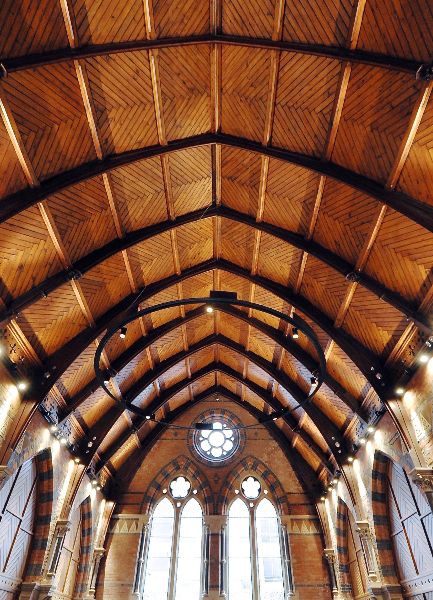
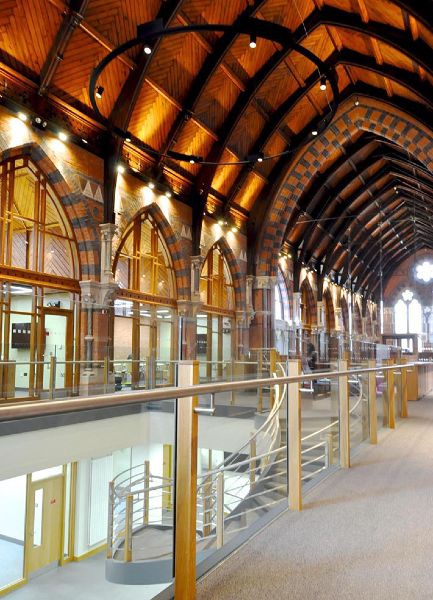
queen’s university, the public university of the city of belfast, is the most important cultural centre for education and research in northern ireland, as well as being one of the most important pieces of architecture in the region. its façade is an admirable example of the neo-gothic style of the mid nineteenth century and has become a symbol of the city itself; its image has even been reproduced on the bank of ireland’s five pound note as well as forming the backdrop to the news bulletins of northern Ireland news in moscow. today the university is made up of more than two hundred and fifty buildings, of which the majority are included in the national list of buildings of special architectural or historic interest. built over the course of more than a century, it displays an extraordinary, but at the same time harmonious, multiplicity of architectural styles: from the expressive drama of the gothic of the central building, the lanyon building, to the international style of the sixties of the ashby building. it is not just the buildings that are the focus of special attention on the part of northern irish institutions, but the open areas and those accessible to the public are also the subject of interest on a historic and panoramic level: the quadrangle, the trees and the broad avenues are indeed key players in the entire complex contributing enormously to the distinctive character of this part of south belfast. queen’s university was founded, along with the academies of cork and galway, following peel’s irish colleges act of 1845. the site chosen was in an area of rapid expansion on the southern periphery of the city, close to the botanical gardens, now annexed to the campus, that had been created in 1841. it was founded to promote higher education for catholics and presbyterians, as a counterpart to trinity college of dublin, which in turn was attended by anglicans. sir charles lanyon was chosen as the architect for the design of the main building, today called the lanyon building. it was completed in 1849 following a design whose style was gothically inspired with a tudor architectural character, but it was not long before it was required to be enlarged. in 1865 a design by william henry lynn, who had previously collaborated with charles lanyon in the design of the main building, was chosen by the adjudicating commission as the most suitable, both in terms of aesthetics and functionality, to fulfil the functions of the library, which was built between 1866 and 1868 faithfully following the existing building’s gothic style of architecture. from an academy, the institution formally became a university in 1908 and in 1911, it was decided to expand the library; the design was again entrusted to lynn who submitted a design that fitted in seamlessly with the previous one, with a wonderful dome acting as a link between the two parts. very close to religious architecture in form, as designed by lynn it was to be presented as an extraordinary and magnificent high internal gallery opened at the sides with colonnades. in 1952 john mcgeagh inserted an intermediate floor of high proportions, while in 1983 the architects twist and whitley added a glass mezzanine and a staircase in order to connect the two levels. the recent restoration entrusted to the consarc design group of belfast offered the opportunity to restabilise the upper floor and return to the city, and to the delight of all visitors, the rich details of the space and the dense wooden ceiling punctuated by imposing gothic arch ribs. in this design, the lighting system is not conceived with purely functional or archaeological values, to evoke the atmosphere of the past, but to enhance the architecture and craftsmanship of the finish indulging the full range of actions of its visitors: looking, reading, studying, speaking, walking, admiring… loving. the new restoration project, in addition to redefining the interior spaces and carefully enhancing the existing architectural elements, also included the construction of a new modern glass façade 11 metres high together with the restoration of the gothic windows facing the central hall. this work enables a proper mix of natural and artificial light, satisfying the many uses of each of the rooms.
scroll


 Page loaded in: 0.094 - Powered by Simplit CMS