
projects | Viabizzuno progettiamo la luce
discover all the Viabizzuno designs and projects in collaboration with the world’s leading architects and designers.


 en
en
house at mantova
place:mantova, italia
project:vittorio longheu, roberto bona, marcello bruno, ugo rossi, barbara vivian
lighting project:stingers srl
technical sales consultant:rosella michieletto
this building was constructed on a featureless plot in the middle of the po valley plain, at suzzara in mantova province and that makes it different from many other houses built previously in areas of great landscape value.
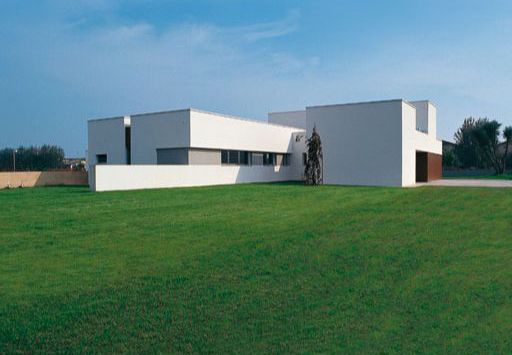
the ordinariness of the residential buildings and of the project location, a haphazard grid of streets and fences, steered the design decisions towards the figuratively abstract, to emphasise the difference between the house and its setting.
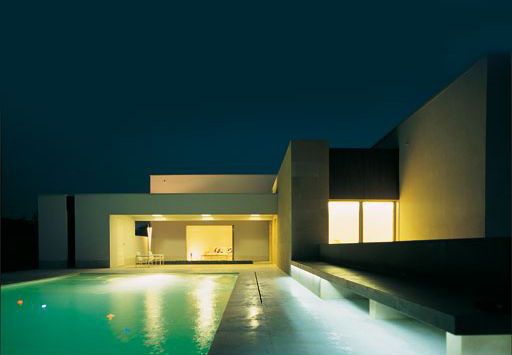
geometry and representation are combined in the juxtaposition of basic shapes which collectively define the residential accommodation through the way they meet: one adjoining another, not forming a barrier but, on the contrary, opening to the outside with the help of private patios and paths.
the house is laid out on one level, the plan emerging from the interplay between rooms of different height, from 2.4 to 4.5 metres.
the section, therefore, becomes symbolic, emphasising the variation in height of the rooms, which are arranged hierarchically, starting with the main core of shared spaces in the living area.
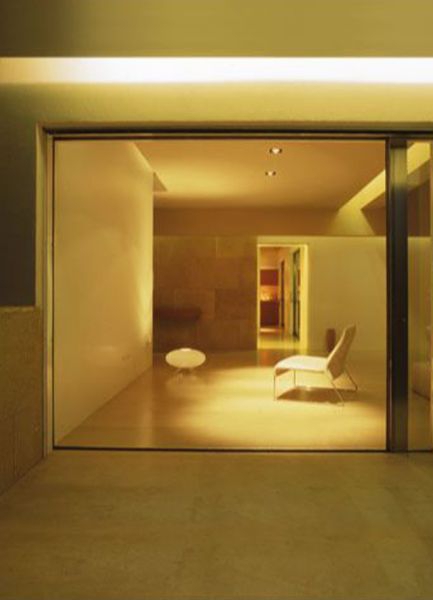
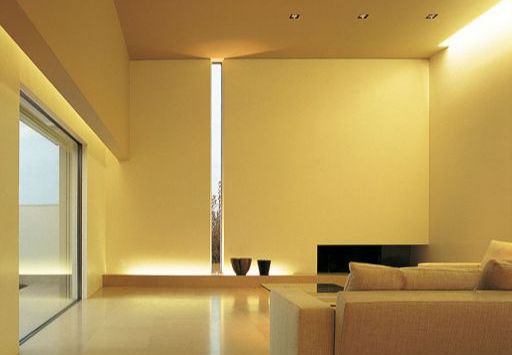
the differences between elements are highlighted by the slots in the roof slab and the patterns of light they create on the floor, making the transition from one space to another distinctive, linking the perception of a simple disciplined space to the emotion generated by the overhead light when meeting the tactile quality of the materials and the formal purity of the detailing. the design of the house, therefore, corresponds with the construction of a space conceived from the inside, in a painstaking exercise that reflects on the relationship between the size, shape and significance of domestic spaces.
in this house the actions of the occupants take place through a very precise vocabulary of processes: moving across, studying at close quarters and gauging space through observation. the scene of activity discovers its own identity, not just through the variations in height but also through awareness of the “thresholds” of transition between the rooms, masonry membranes of varying thickness, often accented by the light from overhead.
the act of transition, therefore, finds its measure in the scale of the “threshold”, as formative component of the room, from a physical act to one of meditation and intuition: crossing the threshold actually opens new frontiers and, in such places, observing and seeing are expressions of an emotional awareness of space, in its relationship with natural light. closer to the perimeter, the house reveals the “constituent mechanisms” of its interior. its character derives from the volumetric forms it comprises, substantially closed off from the road and whose diversity expresses the articulation of the interior space. each shape corresponds to a specific place; the living room is the largest, to the right, next to the aperture of the entrance court that is open towards the street but defined by a beam at its edge. to the left a fully clad wall forms the boundary of a second, enclosed courtyard attached to the study. from thereon, the cladding identifies a service block and ends in a trench next to a portico connected to the study courtyard.
two linear blocks, reaching out towards the natural terrain, house the bedrooms and, bounded by a stone wall, form the boundary of the main courtyard that the shared spaces of the house look on to.
the courtyard is divided in two by an arcade, which separates the dining area and living room from the swimming pool and garden.
all this alternation of domestic spaces or zones creates a rhythm, not just of forms but also of light and shade, so giving life to a design that proves to be consistent and especially harmonious.
.jpg)
scroll


 Page loaded in: 2.995 - Powered by Simplit CMS